Wednesday, January 22, 2020

Greta Thunberg's speech at Davos (January 2020)


https://www.nytimes.com/2020/01/21/climate/greta-thunberg-davos.html

https://www.nytimes.com/2020/01/21/climate/greta-thunberg-davos-transcript.html

https://www.independent.co.uk/voices/davos-greta-thunberg-climate-change-global-warming-a8746536.html

Considering the icy temperatures gripping central Europe, it's remarkable how much hot air was able to circulate in the small town of Davos at over 5,000 feet this week. As per usual, the annual WEF gathering of politicians, business leaders, celebrities and the global media delivered a healthy portion of pomp and splendour. Brexit-weary journalist friends who managed to get their hands on a coveted accreditation shared selfies with Bill Gates, a hastily snapped picture of a star-struck Prince William as he prepared to face David Attenborough, and a shaky video of Wycliffe Jean serenading a dinner crowd. 
The philanthropic (and not so philanthropic) regulars donned their Monclers and rocked up in force – Bono, Al Gore, Matt Damon, George Soros, and Sting, to name but a random few – but when the supposed leaders of the free world got down to the noble business of actually safeguarding our future under the grand theme of "Globalization 4.0", it all got a bit uncomfortable.
The Wall Street Journal's Greg Ip summarised it neatly when he said that Davos's raison d'etre is to gather intelligence and collectively conjure up solutions to the world's most pressing problems. "Hedge funds go to chat up CEOs, CEOs go to chat up politicians, politicians go to chat up donors, and journalists go to chat up everyone," Ip explained in a recent piece, sketching out the weird ecosystem of largely well-heeled attendees. 
But 2019's crippling malaise turns out to be utter cluelessness, making Davos's mission basically unachievable this year. Anyone know how the US government shutdown will finally end, how Brexit will pan out, whether US-China trade tensions will defuse, or whether robots will indeed take all of our jobs? No, nein, non and nyet. But everyone's perfected the art of the sober nod and everyone is eager to express their ironclad commitment to making the world a better place. They just haven't quite got around to figuring out how to 
And so it was with some relief that I learned of at least one sensible voice among the fat cats in the snow. The figurative adult in the room justhappens to be a Swedish teenager. Greta Thunberg is no stranger to the public eye. Last year she led a massive school strike to raise awareness of climate change outside the Swedish parliament. She's done a TED talk and addressed the United Nations Climate Change Conference in Poland last year at the tender age of 15. On Thursday in Davos, unintimidated by the magnitude of her fellow panellists (Bono, diplomat Christiane Figueres, Jane Goodall, will.i.am and Japanese businessman Kengo Sakurada), Thunberg – who also happens to be autistic – took the floor and fearlessly accused some of the planet's richest and most influential people of imperilling her future while looking them dead in the eye.
"Some people say that the climate crisis is something that we will have created, but that is not true, because if everyone is guilty then no one is to blame. And someone is to blame," she said in a stoic, steady voice, as heavyweights like former Goldman Sachs president Gary Cohn and Salesforce CEO Marc Benioff looked on. "Some people, some companies, some decision-makers in particular, have known exactly what priceless values they have been sacrificing to continue making unimaginable amounts of money," she added in flawless English with a charming Scandinavian lilt, before going in for the kill: "And I think many of you here today belong to that group of people."
A short, excruciating pause ensued before a flutter of guilty laughter filled the room and then eventually (thank God!) wordless applause. Many in the audience no doubt wished they were anywhere – anywhere! – but here.
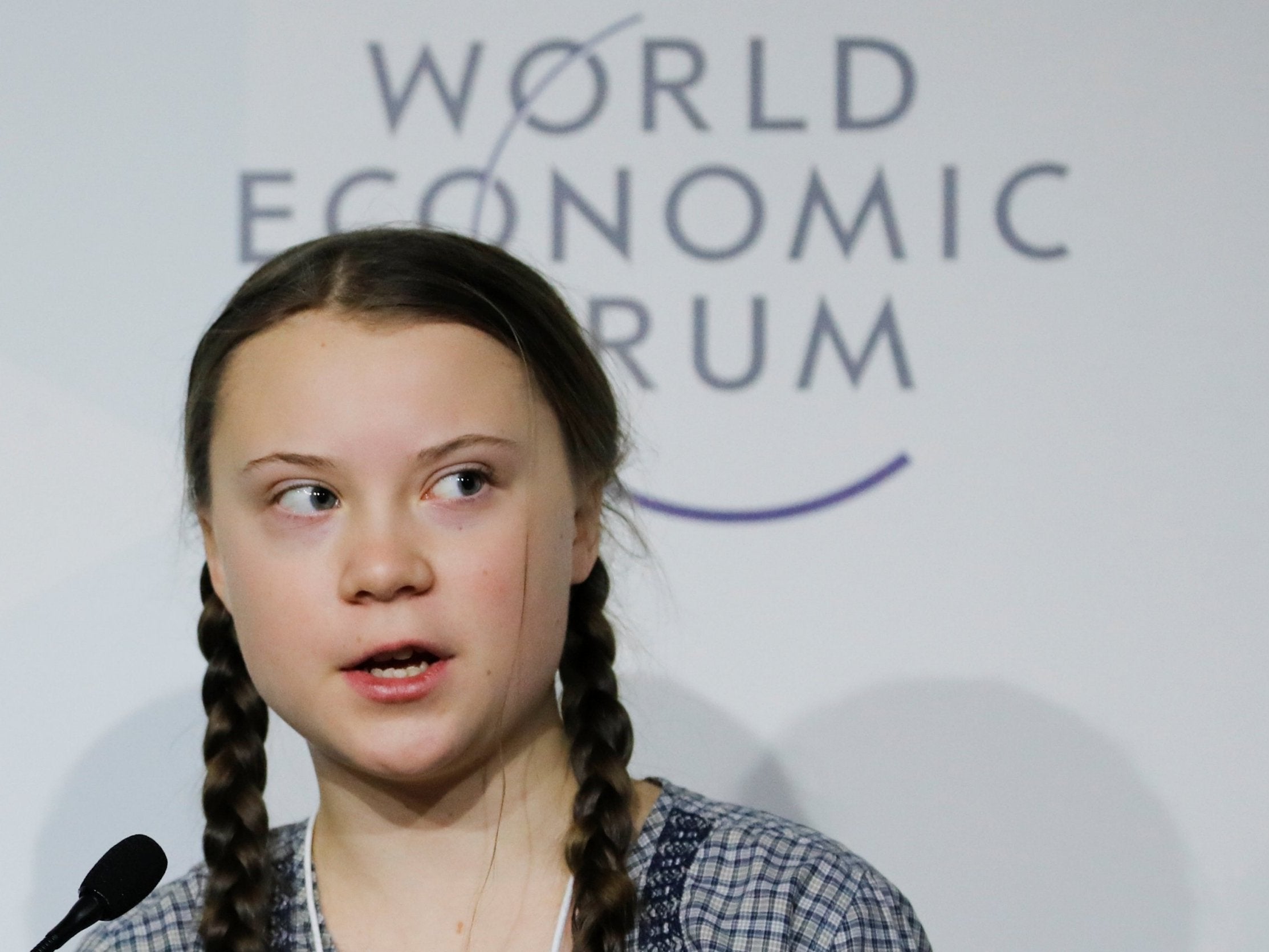


Thunberg, who on Friday was due to meet with WEF founder Klaus Schwab and International Monetary Fund chairwoman Christine Lagarde, truly is leading by example. While some self-proclaimed climate warriors swarmed to the Swiss resort in private jets and choppers, the youngster reportedly endured a more than 30-hour train ride accompanied by her dad. Though no doubt having received reams of offers to stay in fancy hotels for free, she opted to camp in the snow, braving temperatures of -12C and lower. "I want to practise as I preach," she told reporters. 

Thursday, January 2, 2020

Big Data is watching you!

Welcome to the world of surveillance capitalism!
Surveillance capitalism is the practice of Big Data to collect/mine and use our personal information to classify us,predict our behaviour,and sell us products. It is the use of digital technology by corporations to exploit humans.

marketing has become very sophisticated.

smart marketers collect personal data to better understand what  the consumer needs/wants so they can create products to meet tnat demand.
They create psychographic profiles based on the behavior of. people. who viisit their website and tney use AI to predict whst the  consumer is looking for based on their past behaviour.
It is thus used to customize advertizing to specific consumers.

the ethicity of marketing leaves much to be desired:
It is full of deceit,fraud,and outright lies-- all perpetrated in the pursuit of profit/money!

We all want to believe that we are too smart to be manipulated by advertizing. We mistakenly think that we're resistant to marketing.
No one likes to believe they are gullible and not in control of their lives ,that they are being manipulated and have no privacy.
Being continuously tracked/surveilled,  makes one feel unsafe/fearful-- like living in a police/totalitarian state where you'r always being watched.

the collection,storage,and algorhythmic analysis/processing of private data(personal information) should be restricted if not banned

Data bases wch store private information are vulnerable to being breached
if not adequately safeguarded..
A recent cyberattack compromised the personal and health records of most Canadians!
https://torontosun.com/news/national/extremely-troubling-private-health-data-of-15m-canadians-compromised-in-lifelabs-cyberattack

Before downloading an app, please notice thst the app provider requires you to grant access to all kinds of personal information as a condition for using the app!


Saturday, December 14, 2019

reconstructing paradise--the urban landscape of tomorrow

https://wef.ch/2lyoRjg


https://m.facebook.com/story.php?story_fbid=558674121358074&id=681411578662574&sfnsn=mo&d=n&vh=e


https://www.weforum.org/agenda/2019/09/un-plans-vast-urban-forests-fight-climate-change?utm_source=Facebook%20Videos&utm_medium=Facebook%20Videos&utm_campaign=Facebook%20Video%20Blogs

Subject: urban jungle/vertical forests: the agricultural landscape of the future.Reconstructing paradise: the hanging gardens of any metropolis


70% of human population will live in cities by 2050!


as human beings become increasingly urbanized and digjitized (spending more time in cyberspace),they become increasingly disconnected/alienated  from the natural world.

If people are not connected to nature, they are not going to cherish and help to protect it.


Monday, December 9, 2019

The Problem is Capitalism

 George Monbiot on capitalism and the environment :

The Problem is Capitalism 

– George Monbiot


http://cbc.mc.tritondigital.com/CBC_SUNDAYEDITION_P/media/sundayedition-EtCBwIwt-20191206.mp3


Capitalism's failures arise from two of its defining elements. The first is perpetual growth.
 Economic growth is the aggregate effect of the quest to accumulate capital and extract profit. 
Capitalism collapses without growth, yet perpetual growth on a finite planet leads inexorably to environmental calamity.


********************* """"" *
How rethinking capitalism may save the planet:


Posted: Nov 19, 2019 12:00 AM ET | Last Updated: November 19

If the earth is to survive catastrophic climate change, the economies of the world can't continue to grow infinitely. Maintaining the status quo makes ecological viability impossible. Mathematician and philosopher David Schweickart asks whether there is another way forward for capitalism, one in which the choice isn't between the economy and life itself.

************************** "
Naomi Klein's  "This changes everything" states that addressing climate change requires a fundamental change in our economy.
The capitalist model of unlmited economic growth is not sustainable

To continue to be oblivious
(out of sight;out of mind)
to these facts is to give up hope.
We each have to shoulder the blame and address the cause of the problem...by consuming less.
Unless we change our behaviour and learn to consume less,
climate change will continue to get worse!


http://www.cbc.ca/player/play/2688326666/
Naomi Klein’s  book, "This Changes Everything: Capitalism vs. the Climate"

https://www.cbc.ca/radio/thecurrent/the-current-for-june-12-2017-1.4153892/corporate-coup-naomi-klein-says-trump-s-goal-is-to-make-the-rich-richer-1.4153956


:'A transformational vision for the next economy': Naomi Klein on the Green New Deal


we can rise to the existential challenge of the climate crisis if we are willing to change our politica l and economic sysrtrms wch are producing it,making it clear that the battle for a greener world is a fight for our lives.

https://www.cbc.ca/radio/thecurrent/the-current-for-september-17-2019-1.5286346/a-transformational-vision-for-the-next-economy-naomi-klein-on-the-green-new-deal-1.5286814?fbclid=IwAR2dVaoXjWuL7xdzvhhl72zD1J9amUkQ6jEzaRnLQACkdHBk9S8pe_vPcBs


Tuesday, December 3, 2019

Can humanity unite to fight climate change?

Forming bonds in times of crisis

Posted on: November 15, 2019 7:10 pm
by: David Suzuki

Reimagining and acting to create a better world can be a deeply positive experience. In the act of coming together, we can rewire the status quo so that taking care of each other becomes the priority. (Photo: David Suzuki Foundation via Flickr)
The climate and ecological crises touch each of us to varying degrees. Some carry the emotional weight of worrying about what kind of diminished, unstable world we're leaving for our children while others are directly, physically affected by climate-fuelled disasters like storms, wildfires, droughts and changing wildlife patterns.
Our responses to these crises also vary. Most people know the traditional reactions to crises: fight, flight or freeze. But as climate scientist and activist Susanne Moser says, "We keep talking about the three Fs but there is a fourth one, and that's the one that actually helped us survive. The forming of bonds, or the be-friending. That's the piece that got to us to cooperate as a species and recognize that we have greater advantage when we work together as opposed to everyone for themselves. This is biology. It is in the genetic history of our species. We are here because we cooperated. It's part of us."
Naomi Klein's book The Shock Doctrine examines how capitalism takes advantage of disasters, always ready to profit from the destabilization they create. On the flip side, a new phrase has emerged to recognize the human capacity to co-operate in the face of calamity — "disaster collectivism" — described by writer Rebecca Solnit as "the sense of immersion in the moment and solidarity with others caused by the rupture in everyday life, an emotion graver than happiness but deeply positive."
This term has emerged from the displays of compassion, altruism and creative solution-seeking that blossom when climate disaster strikes communities. News reports are full of stories about neighbours and strangers going out of their way to share food, rescue pets, locate loved ones and help rebuild what has been lost.
Acute stress may actually lead to greater cooperative, social, and friendly behavior.
Although disaster collectivism was coined in 2018 in conjunction with the dizzying increase in climate-caused calamities, the phenomenon of the potential of positive reaction to stress has been documented by scientists. A 2012 article in Scientific American, "How the Stress of Disaster Brings People Together," points to studies that found, "acute stress may actually lead to greater cooperative, social, and friendly behavior."
Margaret Klein Salamon, founder and executive director of U.S.-based The Climate Mobilization, argues that society actually needs to enter "emergency mode" in which "individuals and groups function optimally during an existential or moral crisis?—?often achieving great feats through intensely focused motivation."
The climate and ecological crises are manifest in destroyed homes and livelihoods during floods, hurricanes and tornadoes, drastic declines in wildlife populations and the disappearances of vast tracts of forests consumed by increased wildfires, but they are ultimately symptoms of the underlying crisis of our societal failure to take responsibility for our impacts on the planet so that it can continue to provide us with stable, life-supporting ecosystems. It is a crisis facing us all, that we created and to which we must respond.
Although we sometimes see our economy as an absolute, as something apart from us, it is our creation, and it can be recreated if we recognize the planetary harms it sets in motion.
The systems we've been using to structure the way we extract resources need to be rethought. Although we sometimes see our economy as an absolute, as something apart from us, it is our creation, and it can be recreated if we recognize the planetary harms it sets in motion.
Ideally, the fissures in the wall that has upheld business-as-usual operations provide an opportunity for us to come together, equipped with tools to redress, repair and rebuild. Some of the fixes will be technological, like better ways to make renewable energy sources accessible and affordable everywhere, but what is mainly needed is a new vision that sets limits to better manage the pace and reach of our historically unrestrained plundering of the planet's offerings.
Reimagining and acting to create a better world can be a deeply positive experience, as Solnit highlights. In the act of coming together, we can also rewire the status quo so that taking care of each other becomes the norm.
As Barry Lopez observes in his book, Horizon, "Our question is no longer how to exploit the natural world for human comfort and gain, but how we can cooperate with one another to ensure we will someday have a fitting, not a dominating, place in it." Change isn't easy, but when people come together for the good of humanity and Earth, we can accomplish great things.


https://davidsuzuki.org/story/forming-bonds-in-times-of-crisis/


Thursday, November 21, 2019

Would anyone select this person to be their leader?!


Robert Mueller, in his first public statement about his Russia probe, did not exonerate President Trump, instead explaining why his office never considered indicting him for obstruction of justice.

"If we had confidence the President clearly did not commit a crime, we would have said so" 
    --Robert Mueller

********************


Trump blackmails Ukraine with Bidens' and Burisma company investigations

U.S. adviser of the National Security Council Tim Morrison confirmed the manipulations with military aid on the half of the American Side
16:15, 1 November 2019
Russia and Europe adviser on the National Security Council Tim Morrison testified in the Congress that U.S. President Donald Trump delayed the military aid for Ukraine demanding the statement about initiating the investigation against Bidens and Ukrainian Burisma company. CNN reported it referring to the informed sources. 
Particularly, Morrison confirmed last week's testimony from Taylor, currently the top US diplomat in Ukraine, about interactions the two had regarding the President's efforts to press for investigations while US aid to Ukraine was held up. 
Related: Biden slams Trump for dismissing Russian election interference
Morrison also said that US Ambassador to the European Union Gordon Sondland also confirmed that Trump would unblock the military aid for Ukraine in case the President of Ukraine or the Prosecutor General would announce the start of the investigation. 


Monday, November 18, 2019

to save the world we have to think beyond ourselves!


https://www.facebook.com/570361047/posts/10156807781781048/

https://m.facebook.com/story.php?story_fbid=10156807781781048&id=570361047


*********** "*************
Two roads diverged:

Tribalism vs human solidarity

Competition vs cooperation: blindsided by petty internal bickering

As long as we're fighting/quarreling among ourselves,(warring with each other)
we won't see the real enemy (climate change) coming!!
We may become so preoccupied with ,petty infighting that we are caught off guard.


https://m.facebook.com/story.php?story_fbid=10104490644095288&id=25713691&anchor_composer=false&_ft_=mf_story_key.10104490644095288%3Atop_level_post_id.10104490644095288%3Atl_objid.10104490644095288%3Acontent_owner_id_new.25713691%3Athrowback_story_fbid.10104490644095288%3Aphoto_id.10104490643481518%3Astory_location.4%3Astory_attachment_style.video_inline%3Athid.25713691%3A306061129499414%3A2%3A0%3A1561964399%3A-871541924426791994&__tn__=%2AW-R

Tragedy/adversity  brings people together.
Perhaps the ecosystem crises that threatens the planet will unite humanity if we can see this event  as our common enemy requiring cooperation  to achieve a common goal.
Climate change deniers are isolationists--more interested in building walls rather than bridges.
They resist unificatjon/globalization .
.To them subordinating one's personal interests
for the common good is perceived as a threat.
The climate crises is a global calamity that can only be
solved through a unified global response.
If humanity fails to unite (bring an end to war)for the purpose of achieving this common goal
they cannot overcome this threat.
At a time when unity and solidarity among the global community was never more critical ,populist leaders are pulling away from international  cooperation (globalism)
.Putting their own interests ahead of those of humanity could see efforts to address globall problems unravel.
Dealing with climate change  requires  a cooperative effort on the part of the  international community.
In today's world where we are dealing with wars,extremism, hatred,oppression,isolationism ,and negativity...it's wonderful to see that humanity can set all that aside and work collaborative!y toward  one goal.
.It's a pity that politicians don't seem to be able to work together in the same way.