The nexus between poverty and crime/violence
https://m.facebook.com/story.php?story_fbid=pfbid02G6YxqQHiGKzvWwa8QQ43i4GnCwoAuidQguysJizgaAAcjAt7PLpKxbk2CPRX535Kl&id=516732729&mibextid=Nif5oz
“Put a rat in a cage and give it 2 water bottles. One is just water and one is water laced with heroin or cocaine. The rat will almost always prefer the drugged water and almost always kill itself in a couple of weeks. That is our theory of addiction.
Bruce comes along in the ’70s and said, “Well, hang on. We’re putting the rat in an empty cage. It has nothing to do. Let’s try this a bit differently.” So he built Rat Park, and Rat Park is like heaven for rats. Everything a rat could want is in Rat Park. Lovely food. Lots of sex. Other rats to befriend. Colored balls. Plus both water bottles, one with water and one with drugged water. But here’s what's fascinating: In Rat Park, they don’t like the drugged water. They hardly use it. None of them overdose. None of them use in a way that looks like compulsion or addiction. What Bruce did shows that both the right-wing and left-wing theories of addiction are wrong. The right-wing theory is that it’s a moral failing, you’re a hedonist, you party too hard. The left-wing theory is that it takes you over, your brain is hijacked. Bruce says it’s not your morality, it’s not your brain; it’s your cage. Addiction is largely an adaptation to your environment.
Now, we created a society where significant numbers of us can't bear to be present in our lives without being on something, drink, drugs, sex, shopping... We’ve created a hyperconsumerist, hyperindividualist, isolated world that is, for many of us, more like the first cage than the bonded, connected cages we need.
The opposite of addiction is not sobriety. The opposite of addiction is connection. And our whole society, the engine of it, is geared toward making us connect with things not people. You are not a good consumer citizen if you spend your time bonding with the people around you and not stuff. In fact, we are trained from a young age to focus our hopes, dreams, and ambitions on things to buy and consume. Drug addiction is a subset of that."
Credit: Johann Hari
**************
Societal stressors have triggered a mental health crisis! Incapacity to cope with life stressors is the root cause of substance abuse addiction
"Cost-of-living" crisis.
Overall inflation has increased the cost of food and shelter ,and made the cost of living unaffordable...
Young people are feeling disillusioned,alienated, and defeated...and nihilistic! You do what you have to to provide for yourself ---to survive.
Impoverished persons cannot pursue/access justice through the courts
The challenge is not increasing economic growth, but one of distribution-- of redistributing the abundance acrued by the economy more equitably .(basic minimum income) ---reinvesting in /re-enforcing the social safety net. Instead of addressing the root cause of the alienation, (denying access to resources),society chooses the punitive option(criminalization of poverty /incarceration)
You can provide a person with the resources to flourish (guaranteed basic income),, or you can cage them at the cost of $115,000./person/year
Oppression,injustice,disenfranchisement is achieved through the legal /court system. The legal institution is designed to maintaining the hierarchy, to favour the interests of the elite (the wealthy and the powerful)
When people realize the system is rigged, they opt out of it and resort to other options for settling their grievances and getting what they need, such as illegal behavior. The social contract is no longer binding. .They are no longer a stakeholder.
"You do what you have to to provide for yourself ---to survive."
When people are denied access to education,employment,housing,basic income ...they become nihilistic.
Denied a share in any of it...they just want to burn it all down!
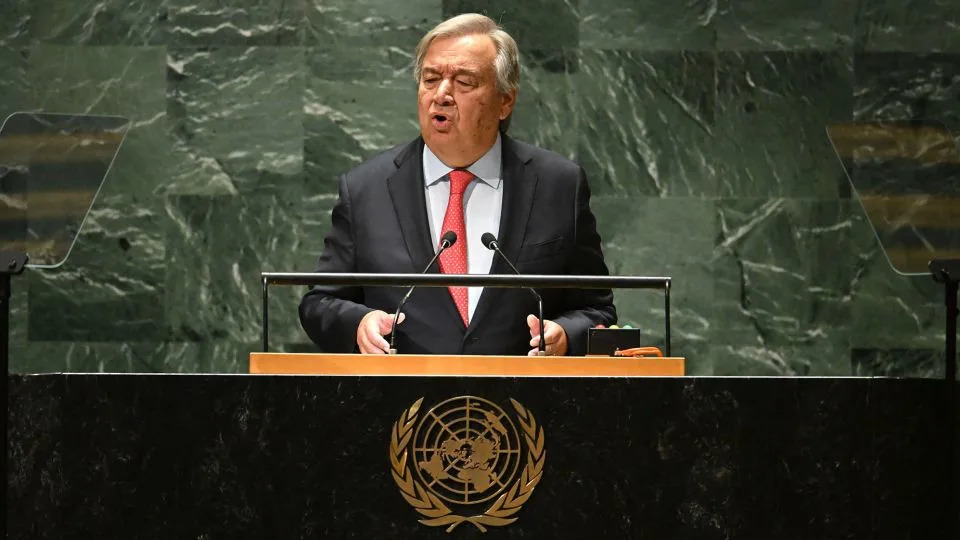
https://www.theguardian.com/world/video/2023/sep/19/world-is-becoming-unhinged-un-chief-antonio-guterres-tells-general-assembly-video?ref=upstract.com
United Nations Secretary-General Antonio Guterres has warned of a looming “Great Fracture” in the world, describing existing global governance structures as failing to serve a changing world.
Speaking before world leaders in the United Nations Assembly Hall on Tuesday, Guterres called for sweeping changes to multilateral institutions, including reforming the powerful Security Council at the heart of the United Nations, and redesigning global financial systems.
“The alternative to reform is not the status quo. The alternative to reform is further fragmentation,” he said. “It’s reform or rupture.
“We are inching ever closer to a Great Fracture in economic and financial systems and trade relations,” he said. “One that threatens a single open Internet, with diverging strategies on technology and artificial intelligence, and potentially clashing security frameworks.”
Guterres described increasing global multipolarity as heralding “new opportunities for justice and balance in international relations” – an acknowledgment of the rise of new powers in the world like India and China, and growing negotiating power of regional blocs. But to ensure peace between nations in a multipolar order, new and strengthened multilateral institutions are all the more important, he added.
The United Nations Security Council and Bretton Woods agreement still reflect the unequal power relations of 1945, Guterres said, “when many countries in this Assembly Hall were still under colonial domination.”
The Security Council is made up of five permanent members – the US, the UK, France, China, Russia – and 10 rotating members. Only one leader from the permanent five members – US President Joe Biden – chose to attend the UN General Assembly this year.
More than 50 UN countries have never been members of the Security Council.
Guterres’ speech hit on long list of smoldering global issues, including bloody violence in Sudan, the Central African Republic, and Haiti; oppression in Myanmar and Afghanistan; and the potential threats of unfettered new technologies, including artificial intelligence.
It also devoted significant attention to climate change, a central issue for Guterres, with the secretary-general taking aim at G20 countries for producing the majority of global emissions amid rising global temperatures, and calling on wealthy nations to deliver billions in promised funding to strengthen developing nations against climate-related threats.
In a notable aside to environmental activists around the world – and on the streets of New York this week – Guterres said, “To all those working, marching and championing real climate action, I want you to know: You are on the right side of history. I’m with you.”
The secretary-general’s address echoed criticisms that he has previously aired of division in the world. In 2021, with parts of the world still gripped by Covid-19, Guterres said the world was “getting an F in ethics.” In 2022, the secretary-general warned the international community was “gridlocked in colossal global dysfunction” – though he pointed to the Black Sea Grain Initiative that opened delivery paths for Ukrainian grain to countries in need as a vital point of hope.
One year later, however, the grain deal has collapsed. And as Russia’s war in Ukraine grinds on, the geopolitical conditions for joint action to stave off humanitarian and environmental disasters can seem further away than ever.
“We have a level of division among superpowers that has no precedent since the Second World War,” Guterres observed in an interview with CNN’s Christiane Amanpour on Monday, ahead of his speech.
All he has to bridge that division, he told Amanpour, is a voice.
“The secretary-general of the United Nations has no power and there’s no money. What we have is a voice. And that voice can be loud. And I have the obligation to make it be loud.”
For more CNN news and newsletters create an