The City of Eridu is the Oldest on Earth, It's Largely Unexplored
By Michael Chary | January 20, 2022 | Seeking Truth, Ancient Origins, Ancient Civilizations Decoded
The Ruins Of Eridu, oldest city in the world Over the past decade, there have been a number of archeological revelations pushing back the timeline of human evolution and our ancient ancestors' various diasporas. Initially, these discoveries elicit some resistance as archeologists bemoan the daunting prospect of rewriting the history books, though once enough evidence is presented to established institutions, a new chronology becomes accepted.
But this really only pertains to the era of human development that predates civilization — the epochs of our past in which we were merely hunter-gatherers and nomads roaming the savannahs. Try challenging the consensus timeline of human civilization and it's likely you'll be met with derision and rigidity.
Conversely, someone of an alternative persuasion may profess stories of ancient civilizations, such as Atlantis or Lemuria, with speculative mythology recounting a lost, golden age in human history that was surely responsible for building the pyramids and other wonders of the world. They point to the writings of Solon and Plato as evidence for these ancestors' existence, which is exciting but difficult to corroborate without physical proof.
Researcher Matt LaCroix seems to find himself somewhere in the middle of these two perspectives. While he says he's fascinated by the Athenian clues detailing the destruction of Atlantis, he finds more compelling evidence in ancient Mesopotamia, or what academia already acknowledges as "the cradle of civilization."
It's here we find the ruins of the most ancient city on Earth that we have physical proof of — the city of Eridu. This archaic metropolis is well-documented in historical texts covering ancient Sumer and the Babylonian empire, but there's also a mythological component to Eridu that may imply human civilization is far older than we believe — significant orders of magnitude older.
Video Player is loading.This is a modal window. Could not download the video Error Code: PLAYER_ERR_TIMEOUT Session ID: 2023-02-26:e6873009e46a9b718fef3f19 Player Element ID: bc-player-111 OK Close Modal Dialog That mythological component comes from the Sumerian King List; a record of ancient monarchs and demi-gods dating back more than 250,000 years to the time when "kingship first descended from heaven."
This royal chronicle ostensibly reads like mythology, with early kings said to have lived and ruled for tens of thousands of years, particularly during the antediluvian era. After the flood, however, the kings' reigns begin to shorten to hundreds of years — much like some of the patriarchs of the Old Testament — and eventually to lifespans matching our modern mortality. Not to mention, there's proof that the names of some of the more contemporary kings on the list did, in fact, exist.
The attempts to preserve documentation of this wildly ancient lineage trace back to the last great Assyrian king, Ashurbanipal, who ruled several thousand years ago. Thanks to his efforts compiling a massive library of Sumerian culture that was already ancient in his day, we have texts including the Epic of Gilgamesh and the Enūma Eliš that survived into modernity. Millennia later, these texts outlining the Sumerian pantheon would be discovered and translated by Austen Henry Layard, before then being famously interpreted by Zecharia Sitchin.
Sitchin's translations inspired many to ascribe to the idea that the Anunnaki gods of Sumerian lore were an extraterrestrial race of humanity's progenitors. LaCroix says Sitchin's perspective intrigued him at first too, but as he dug deeper he found details the alternative scholar got wrong. Namely, the idea that humans were created as a slave species for an industrious race of alien overseers who used humans to mine precious earth minerals.
Instead, LaCroix says the texts describe an incredible effort by a subset of the Anunnaki known as the Igigi, to build infrastructure on Earth that would allow civilization to flourish before creating mankind as a perfect species with the potential to ascend to enormous power — maybe even more than the Anunnaki themselves.
According to LaCroix, there may have been a number of times we came close to reaching that potential throughout our history on this planet, but we've been set back by natural disasters and conflict. These setbacks have sadly continued over the past decade as the war in the Middle East has led to the destruction of precious artifacts that could give us more insight into, arguably, the most important period in human history. These artifacts, particularly the countless cuneiform tablets in places like Nineveh, have been looted and sold on black markets around the world.
And if these sites are not being destroyed by religious extremists, they're being largely ignored by archeologists. A prime example of this is Eridu and its iconic ziggurat, the temple of E-Abzu, which remains buried in the sands of southern Iraq. According to Sumerian legend, Eridu was established by, and home to the Annunaki god Enki, himself. Here, cuneiform tablets are literally sticking up out of the sand waiting for the right people to come along, preserve them, and unlock the lost secrets of humanity.
To learn more about LaCroix's work to help preserve these records watch Eridu: City of Gods on Open Minds with Regina Meredith.
About the Author Image of Author With a pedigree in journalism, Michael Chary quickly became disenchanted with its mainstream narratives, opting instead to delve into the alternative and esoteric. A fan of the works of Graham Hancock, Daniel Pinchbeck, and Howard Zinn, Chary has learned there is more to our reality than we've been told.
US 30 trillion. debt is mostly borrowed from China.If China calls in its loan it would cause a default wch would trigger a global financial and economic collapse. The global financial system is volatile and unstable and would topple like a house of cards. America's. only response would be to keep raising its "debt ceiling" (allowing it to borrow more money),and for the central bank (federal reserve) to print more money (so-called "quantitative easing"!). But this action devalues the currency (i.e. decreases the buying power of the currency)as people lose trust in the value of. paper money. (the value of money is measured by how much you can buy with it!). This results in having to pay more and more for the same item(inflation).
Even at a modest interest rate of 5%, the debt service cost for 30 trillion dollars is 1.5 trillion.This is close to 100 % of US annual budget (1.45 trillion) and 5,370 % of its 2023 GDP.($26,695.58B)
Think of all the good this money could do if it were used for constructive purposes instead of preparing for war!
Think what this money could do to solve poverty,inequality,injustice,disease,hunger! Think of the resources that are diverted from humanitarian purposes!
World military expenditure passes $2 trillion for first time
In 2020, the total world military expenditure was about $1.981 trillion.
In 2021 humanity spent 2.2% of the global GDP on military spending
As a result of a sharp economic recovery in 2021, the global military burden—world military expenditure as a share of world gross domestic product (GDP)—fell by 0.1 percentage points, from 2.3 per cent in 2020 to 2.2 per cent in 2021.
United States focuses on military research and development
US military spending amounted to $801 billion in 2021, a drop of 1.4 per cent from 2020. The US military burden decreased slightly from 3.7 per cent of GDP in 2020 to 3.5 per cent in 2021.
*********
World military expenditure passes $2 trillion for first time
25 April 2022
World military expenditure passes $2 trillion for first time
World military expenditure, by region, 1988–2021
(Stockholm, 25 April 2022) Total global military expenditure increased by 0.7 per cent in real terms in 2021, to reach $2113 billion. The five largest spenders in 2021 were the United States, China, India, the United Kingdom and Russia, together accounting for 62 per cent of expenditure, according to new data on global military spending published today by the Stockholm International Peace Research Institute (SIPRI).
Military expenditure reaches record level in the second year of the pandemic
World military spending continued to grow in 2021, reaching an all-time high of $2.1 trillion. This was the seventh consecutive year that spending increased.
'Even amid the economic fallout of the Covid-19 pandemic, world military spending hit record levels,' said Dr Diego Lopes da Silva, Senior Researcher with SIPRI's Military Expenditure and Arms Production Programme. 'There was a slowdown in the rate of real-terms growth due to inflation. In nominal terms, however, military spending grew by 6.1 per cent.'
As a result of a sharp economic recovery in 2021, the global military burden—world military expenditure as a share of world gross domestic product (GDP)—fell by 0.1 percentage points, from 2.3 per cent in 2020 to 2.2 per cent in 2021.
United States focuses on military research and development
US military spending amounted to $801 billion in 2021, a drop of 1.4 per cent from 2020. The US military burden decreased slightly from 3.7 per cent of GDP in 2020 to 3.5 per cent in 2021.
US funding for military research and development (R&D) rose by 24 per cent between 2012 and 2021, while arms procurement funding fell by 6.4 per cent over the same period. In 2021 spending on both decreased. However, the drop in R&D spending (–1.2 per cent) was smaller than that in arms procurement spending (–5.4 per cent).
'The increase in R&D spending over the decade 2012–21 suggests that the United States is focusing more on next-generation technologies,' said Alexandra Marksteiner, Researcher with SIPRI's Military Expenditure and Arms Production Programme. 'The US Government has repeatedly stressed the need to preserve the US military's technological edge over strategic competitors.'
Russia increases military budget in run-up to war
Russia increased its military expenditure by 2.9 per cent in 2021, to $65.9 billion, at a time when it was building up its forces along the Ukrainian border. This was the third consecutive year of growth and Russia's military spending reached 4.1 per cent of GDP in 2021.
'High oil and gas revenues helped Russia to boost its military spending in 2021. Russian military expenditure had been in decline between 2016 and 2019 as a result of low energy prices combined with sanctions in response to Russia's annexation of Crimea in 2014,' said Lucie Béraud-Sudreau, Director of SIPRI's Military Expenditure and Arms Production Programme.
The 'national defence' budget line, which accounts for around three-quarters of Russia's total military spending and includes funding for operational costs as well as arms procurement, was revised upwards over the course of the year. The final figure was $48.4 billion, 14 per cent higher than had been budgeted at the end of 2020.
As it has strengthened its defences against Russia, Ukraine's military spending has risen by 72 per cent since the annexation of Crimea in 2014. Spending fell in 2021, to $5.9 billion, but still accounted for 3.2 per cent of the country's GDP.
Continued increases by major spenders in Asia and Oceania
China, the world's second largest spender, allocated an estimated $293 billion to its military in 2021, an increase of 4.7 per cent compared with 2020. China's military spending has grown for 27 consecutive years. The 2021 Chinese budget was the first under the 14th Five-Year Plan, which runs until 2025.
Following initial approval of its 2021 budget, the Japanese Government added $7.0 billion to military spending. As a result, spending rose by 7.3 per cent, to $54.1 billion in 2021, the highest annual increase since 1972. Australian military spending also increased in 2021: by 4.0 per cent, to reach $31.8 billion.
'China's growing assertiveness in and around the South and the East China seas have become a major driver of military spending in countries such as Australia and Japan,' said SIPRI Senior Researcher Dr Nan Tian. 'An example is the AUKUS trilateral security agreement between Australia, the United Kingdom and the United States that foresees the supply of eight nuclear-powered submarines to Australia at an estimated cost of up to $128 billion.'
Other notable developments:
In 2021 Iran's military budget increased for the first time in four years, to $24.6 billion. Funding for the Islamic Revolutionary Guard Corps continued to grow in 2021—by 14 per cent compared with 2020—and accounted for 34 per cent of Iran's total military spending.
Eight European North Atlantic Treaty Organization (NATO) members reached the Alliance's target of spending 2 per cent or more of GDP on their armed forces in 2021. This is one fewer than in 2020 but up from two in 2014.
Nigeria raised its military spending by 56 per cent in 2021, to reach $4.5 billion. The rise came in response to numerous security challenges such as violent extremism and separatist insurgencies.
Germany—the third largest spender in Central and Western Europe—spent $56.0 billion on its military in 2021, or 1.3 per cent of its GDP. Military spending was 1.4 per cent lower compared with 2020 due to inflation.
In 2021 Qatar's military spending was $11.6 billion, making it the fifth largest spender in the Middle East. Qatar's military spending in 2021 was 434 per cent higher than in 2010, when the country last released spending data before 2021.
India's military spending of $76.6 billion ranked third highest in the world. This was up by 0.9 per cent from 2020 and by 33 per cent from 2012. In a push to strengthen the indigenous arms industry, 64 per cent of capital outlays in the military budget of 2021 were earmarked for acquisitions of domestically produced arms.
For editors
SIPRI monitors developments in military expenditure worldwide and maintains the most comprehensive, consistent and extensive publicly available data source on military expenditure. The comprehensive annual update of the SIPRI Military Expenditure Database is accessible from today at www.sipri.org.
All percentage changes are expressed in real terms (constant 2020 prices) unless otherwise stated. Military expenditure refers to all government spending on current military forces and activities, including salaries and benefits, operational expenses, arms and equipment purchases, military construction, research and development, and central administration, command and support. SIPRI therefore discourages the use of terms such as 'arms spending' when referring to military expenditure, as this represents only one category of expenditure.
************
global military spending has reached a staggering $2.718 trillion, with the united states accounting for approximately 36.7% of this total, which translates to $997 billion. If all nation states demilitarized, these funds could be redirected towards constructive purposes such as:
- *Education*: Improving infrastructure, hiring qualified teachers, and providing resources for students
- *Healthcare*: Enhancing medical facilities, training healthcare professionals, and increasing access to quality care
- *Sustainable Development*: Investing in renewable energy, reducing carbon emissions, and promoting eco-friendly practices
- *Poverty Reduction*: Supporting initiatives that address income inequality, provide job opportunities, and improve living standards
Here's a breakdown of the top military spenders ¹:
- *United States*: $997 billion (36.7% of global total)
- *China*: $314 billion (11.6% of global total)
- *Russia*: $149 billion (5.5% of global total)
- *Germany*: $88.5 billion (3.3% of global total)
- *India*: $86.1 billion (3.2% of global total)
Redirecting these funds could have a significant impact on global development and stability. For instance, the amount spent on military purposes worldwide could fund ²:
- *Multiple global health initiatives*, such as combating infectious diseases, improving healthcare infrastructure, and enhancing medical research
- *Sustainable infrastructure projects*, like renewable energy, green transportation, and eco-friendly buildings
- *Education and skills training programs*, focusing on vocational training, literacy, and numeracy
The SIPRI report highlights the need for transparency and accountability in military spending, emphasizing the potential benefits of redirecting resources towards more constructive and sustainable purposes ³.
Hydrogen bombs, or thermonuclear bombs, are more powerful than atomic or "fission" bombs. The difference between thermonuclear bombs and fission bombs begins at the atomic level. [The 10 Greatest Explosions Ever]
Fission bombs, like those used to devastate the Japanese cities of Nagasaki and Hiroshima during World War II, work by splitting the nucleus of an atom. When the neutrons, or neutral particles, of the atom's nucleus split, some hit the nuclei of nearby atoms, splitting them, too. The result is a very explosive chain reaction. The bombs dropped on Hiroshima and Nagasaki exploded with the yield of 15 kilotons and 20 kilotons of TNT, respectively, according to the Union of Concerned Scientists.
In contrast, the first test of a therm hydrogen bomb, in the United States in November 1952 yielded an explosion on the order of 10,000 kilotons of TNT. Thermonuclear bombs start with the same fission reaction that powers atomic bombs — but the majority of the uranium or plutonium in atomic bombs actually goes unused. In a thermonuclear bomb, an additional step means that more of the bomb's explosive power becomes available.
First, an igniting explosion compresses a sphere of plutonium-239, the material that will then undergo fission. Inside this pit of plutonium-239 is a chamber of hydrogen gas. The high temperatures and pressures created by the plutonium-239 fission cause the hydrogen atoms to fuse. This fusion process releases neutrons, which feed back into the plutonium-239, splitting more
atoms and boosting the fission chain reaction
*********** "An atom bomb takes a material called uranium and splits it up. That releases a huge amount of energy, a process that's called fission.
"A hydrogen bomb works along a similar theme but has a secondary element to it --a fusion reaction!
Hydrogen bombs were tested by the UK, Russia and America in the 1960s
"After the fission explosion happens it causes a heating of hydrogen and basically sets off a series of further nuclear reactions."
It's often called a two-stage atomic bomb.
"It's very similar to what goes on in the sun,"
Actually the first test of a thermonuclear hydrogen bomb, in the United States in November 1952 yielded an explosion on the order of 10,000 kilotons of TNT. Thermonuclear bombs start with a fission reaction wch generates enuf enerrgy to trigger the hydroggen fusion reaction.
Momentous landmark event in harnessing nuclear fusion energy
Net energy gain achieved in nuclear fusion experiment .
First demonstration that nuclear fusion can be a viable energy source.
Quite possibly the biggest scientific breakthrough of the twenty first century!
Does this mean unlimited clean energy (carbon -free energy)? Will it become practical in time to wean us off fossil fuels and solve the climate crises?
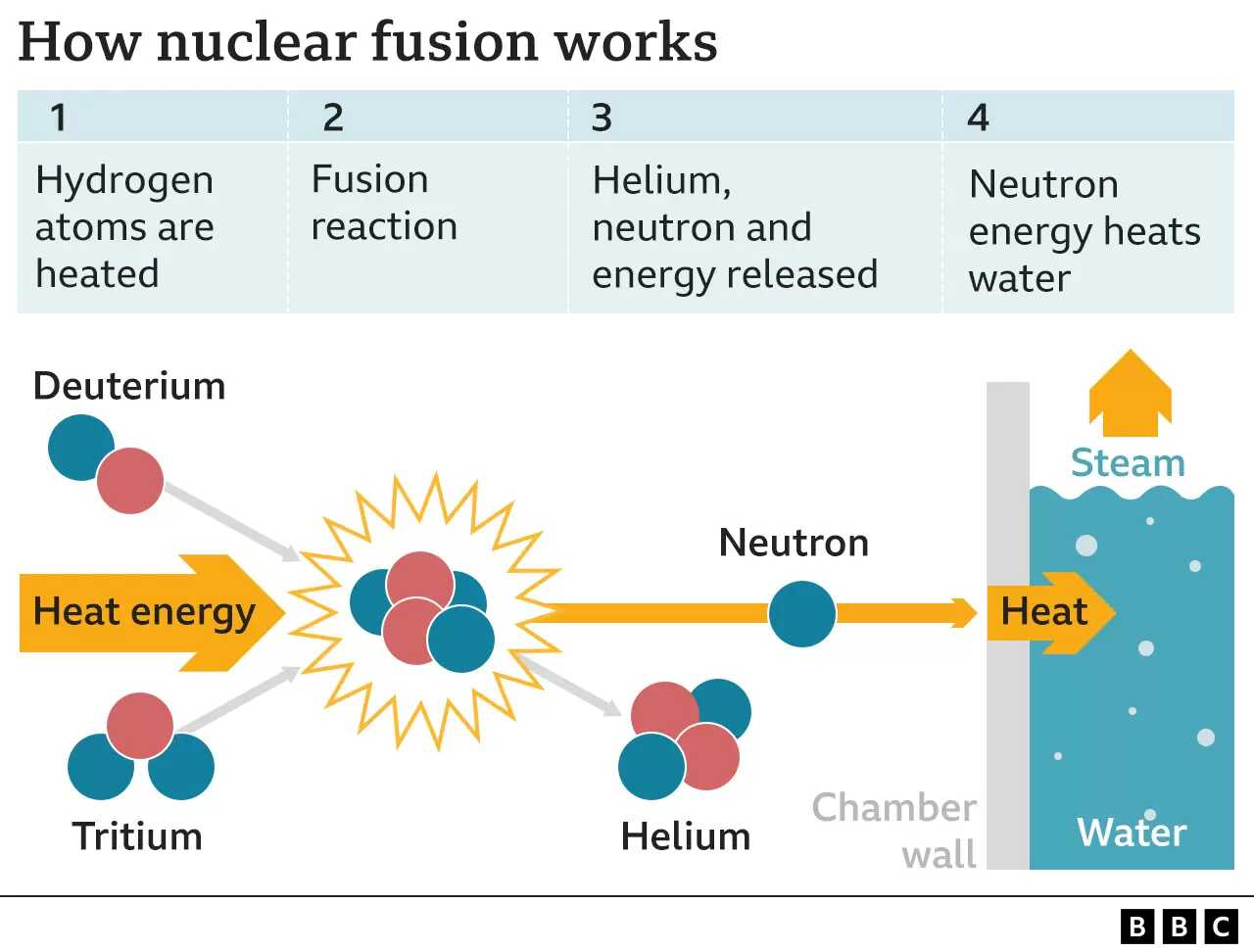
192 high-powered lasers focused on a pellet of hydrogen triggered a nuclear fusion reaction. (fusing hydrogen into helium with a release of energy)
***********
Major nuclear fusion energy breakthrough
December’s nuclear energy breakthrough occurred at the National Ignition Facility, which uses a process called “thermonuclear inertial fusion.”
Essentially, the $3.5 billion laser complex shoots 192 lasers at a tiny capsule. The capsule contains two hydrogen isotopes that, when bombarded with energy, vaporize almost immediately. The fusion process releases enormous amounts of energy.
In the past, the energy input from the lasers far exceeded the energy output from the fusion reaction. But on December 5, researchers tried something new.
The shell around the capsule they used was thicker than in past experiments, meaning that small flaws effect the experiment less. This simple – and incredibly replicable – change allowed something incredible to happen.
Dr. Marvin Adams, NNSA Deputy Administrator for Defense Programs, described the process at Tuesday’s press conference. He noted that the process began with a spherical cylinder containing a small capsule, “about half the diameter of a BB.”
“192 laser beams entered from the two ends of the cylinder,” he said, “and struck the inner wall…. X-rays from the wall impinged on the spherical capsule. Fusion fuel in the capsule got squeezed, fusion reactions started. This had all happened before, 100 times before. But last week for the first time, they designed this experiment so that the fusion fuel stayed hot enough, dense enough and round enough for long enough that it ignited. And it produced more energies than the lasers had deposited. About 2 megajoules in, about 3 megajoules out. A gain of 1.5.
Use of psychedelics drugs to induce mystical states of consciousness
The Trip Treatment
On an April Monday in 2010, Patrick Mettes, a fifty-four-year-old television news director being treated for a cancer of the bile ducts, read an article on the front page of the Times that would change his death. His diagnosis had come three years earlier, shortly after his wife, Lisa, noticed that the whites of his eyes had turned yellow. By 2010, the cancer had spread to Patrick's lungs and he was buckling under the weight of a debilitating chemotherapy regimen and the growing fear that he might not survive. The article, headlined "Hallucinogens Have Doctors Tuning in Again," mentioned clinical trials at several universities, including N.Y.U., in which psilocybin—the active ingredient in so-called magic mushrooms—was being administered to cancer patients in an effort to relieve their anxiety and "existential distress." One of the researchers was quoted as saying that, under the influence of the hallucinogen, "individuals transcend their primary identification with their bodies and experience ego-free states . . . and return with a new perspective and profound acceptance." Patrick had never taken a psychedelic drug, but he immediately wanted to volunteer. Lisa was against the idea. "I didn't want there to be an easy way out," she recently told me. "I wanted him to fight."
Psilocybin may be useful in treating anxiety, addiction, and depression, and in studying the neurobiology of mystical experience.Illustration by Stephen Doyle
Patrick made the call anyway and, after filling out some forms and answering a long list of questions, was accepted into the trial. Since hallucinogens can sometimes bring to the surface latent psychological problems, researchers try to weed out volunteers at high risk by asking questions about drug use and whether there is a family history of schizophrenia or bipolar disorder. After the screening, Mettes was assigned to a therapist named Anthony Bossis, a bearded, bearish psychologist in his mid-fifties, with a specialty in palliative care. Bossis is a co-principal investigator for the N.Y.U. trial.
After four meetings with Bossis, Mettes was scheduled for two dosings—one of them an "active" placebo (in this case, a high dose of niacin, which can produce a tingling sensation), and the other a pill containing the psilocybin. Both sessions, Mettes was told, would take place in a room decorated to look more like a living room than like a medical office, with a comfortable couch, landscape paintings on the wall, and, on the shelves, books of art and mythology, along with various aboriginal and spiritual tchotchkes, including a Buddha and a glazed ceramic mushroom. During each session, which would last the better part of a day, Mettes would lie on the couch wearing an eye mask and listening through headphones to a carefully curated playlist—Brian Eno, Philip Glass, Pat Metheny, Ravi Shankar. Bossis and a second therapist would be there throughout, saying little but being available to help should he run into any trouble.
I met Bossis last year in the N.Y.U. treatment room, along with his colleague Stephen Ross, an associate professor of psychiatry at N.Y.U.'s medical school, who directs the ongoing psilocybin trials. Ross, who is in his forties, was dressed in a suit and could pass for a banker. He is also the director of the substance-abuse division at Bellevue, and he told me that he had known little about psychedelics—drugs that produce radical changes in consciousness, including hallucinations—until a colleague happened to mention that, in the nineteen-sixties, LSD had been used successfully to treat alcoholics. Ross did some research and was astounded at what he found.
"I felt a little like an archeologist unearthing a completely buried body of knowledge," he said. Beginning in the nineteen-fifties, psychedelics had been used to treat a wide variety of conditions, including alcoholism and end-of-life anxiety. The American Psychiatric Association held meetings centered on LSD. "Some of the best minds in psychiatry had seriously studied these compounds in therapeutic models, with government funding," Ross said.
Between 1953 and 1973, the federal government spent four million dollars to fund a hundred and sixteen studies of LSD, involving more than seventeen hundred subjects. (These figures don't include classified research.) Through the mid-nineteen-sixties, psilocybin and LSD were legal and remarkably easy to obtain. Sandoz, the Swiss chemical company where, in 1938, Albert Hofmann first synthesized LSD, gave away large quantities of Delysid—LSD—to any researcher who requested it, in the hope that someone would discover a marketable application. Psychedelics were tested on alcoholics, people struggling with obsessive-compulsive disorder, depressives, autistic children, schizophrenics, terminal cancer patients, and convicts, as well as on perfectly healthy artists and scientists (to study creativity) and divinity students (to study spirituality). The results reported were frequently positive. But many of the studies were, by modern standards, poorly designed and seldom well controlled, if at all. When there were controls, it was difficult to blind the researchers—that is, hide from them which volunteers had taken the actual drug. (This remains a problem.)
Read classic New Yorker stories, curated by our archivists and editors.
By the mid-nineteen-sixties, LSD had escaped from the laboratory and swept through the counterculture. In 1970, Richard Nixon signed the Controlled Substances Act and put most psychedelics on Schedule 1, prohibiting their use for any purpose. Research soon came to a halt, and what had been learned was all but erased from the field of psychiatry. "By the time I got to medical school, no one even talked about it," Ross said.
The clinical trials at N.Y.U.—a second one, using psilocybin to treat alcohol addiction, is now getting under way—are part of a renaissance of psychedelic research taking place at several universities in the United States, including Johns Hopkins, the Harbor-U.C.L.A. Medical Center, and the University of New Mexico, as well as at Imperial College, in London, and the University of Zurich. As the drug war subsides, scientists are eager to reconsider the therapeutic potential of these drugs, beginning with psilocybin. (Last month The Lancet, the United Kingdom's most prominent medical journal, published a guest editorial in support of such research.) The effects of psilocybin resemble those of LSD, but, as one researcher explained, "it carries none of the political and cultural baggage of those three letters." LSD is also stronger and longer-lasting in its effects, and is considered more likely to produce adverse reactions. Researchers are using or planning to use psilocybin not only to treat anxiety, addiction (to smoking and alcohol), and depression but also to study the neurobiology of mystical experience, which the drug, at high doses, can reliably occasion. Forty years after the Nixon Administration effectively shut down most psychedelic research, the government is gingerly allowing a small number of scientists to resume working with these powerful and still somewhat mysterious molecules.
As I chatted with Tony Bossis and Stephen Ross in the treatment room at N.Y.U., their excitement about the results was evident. According to Ross, cancer patients receiving just a single dose of psilocybin experienced immediate and dramatic reductions in anxiety and depression, improvements that were sustained for at least six months. The data are still being analyzed and have not yet been submitted to a journal for peer review, but the researchers expect to publish later this year.
"I thought the first ten or twenty people were plants—that they must be faking it," Ross told me. "They were saying things like 'I understand love is the most powerful force on the planet,' or 'I had an encounter with my cancer, this black cloud of smoke.' People who had been palpably scared of death—they lost their fear. The fact that a drug given once can have such an effect for so long is an unprecedented finding. We have never had anything like it in the psychiatric field."
I was surprised to hear such unguarded enthusiasm from a scientist, and a substance-abuse specialist, about a street drug that, since 1970, has been classified by the government as having no accepted medical use and a high potential for abuse. But the support for renewed research on psychedelics is widespread among medical experts. "I'm personally biased in favor of these type of studies," Thomas R. Insel, the director of the National Institute of Mental Health (N.I.M.H.) and a neuroscientist, told me. "If it proves useful to people who are really suffering, we should look at it. Just because it is a psychedelic doesn't disqualify it in our eyes." Nora Volkow, the director of the National Institute on Drug Abuse (nida), emphasized that "it is important to remind people that experimenting with drugs of abuse outside a research setting can produce serious harms."
Many researchers I spoke with described their findings with excitement, some using words like "mind-blowing." Bossis said, "People don't realize how few tools we have in psychiatry to address existential distress. Xanax isn't the answer. So how can we not explore this, if it can recalibrate how we die?"
Herbert D. Kleber, a psychiatrist and the director of the substance-abuse division at the Columbia University–N.Y. State Psychiatric Institute, who is one of the nation's leading experts on drug abuse, struck a cautionary note. "The whole area of research is fascinating," he said. "But it's important to remember that the sample sizes are small." He also stressed the risk of adverse effects and the importance of "having guides in the room, since you can have a good experience or a frightful one." But he added, referring to the N.Y.U. and Johns Hopkins research, "These studies are being carried out by very well trained and dedicated therapists who know what they're doing. The question is, is it ready for prime time?"
The idea of giving a psychedelic drug to the dying was conceived by a novelist: Aldous Huxley. In 1953, Humphry Osmond, an English psychiatrist, introduced Huxley to mescaline, an experience he chronicled in "The Doors of Perception," in 1954. (Osmond coined the word "psychedelic," which means "mind-manifesting," in a 1957 letter to Huxley.) Huxley proposed a research project involving the "administration of LSD to terminal cancer cases, in the hope that it would make dying a more spiritual, less strictly physiological process." Huxley had his wife inject him with the drug on his deathbed; he died at sixty-nine, of laryngeal cancer, on November 22, 1963.
Psilocybin mushrooms first came to the attention of Western medicine (and popular culture) in a fifteen-page 1957 Life article by an amateur mycologist—and a vice-president of J. P. Morgan in New York—named R. Gordon Wasson. In 1955, after years spent chasing down reports of the clandestine use of magic mushrooms among indigenous Mexicans, Wasson was introduced to them by María Sabina, a curandera—a healer, or shaman—in southern Mexico. Wasson's awed first-person account of his psychedelic journey during a nocturnal mushroom ceremony inspired several scientists, including Timothy Leary, a well-regarded psychologist doing personality research at Harvard, to take up the study of psilocybin. After trying magic mushrooms in Cuernavaca, in 1960, Leary conceived the Harvard Psilocybin Project, to study the therapeutic potential of hallucinogens. His involvement with LSD came a few years later.
In the wake of Wasson's research, Albert Hofmann experimented with magic mushrooms in 1957. "Thirty minutes after my taking the mushrooms, the exterior world began to undergo a strange transformation," he wrote. "Everything assumed a Mexican character." Hofmann proceeded to identify, isolate, and then synthesize the active ingredient, psilocybin, the compound being used in the current research.
Perhaps the most influential and rigorous of these early studies was the Good Friday experiment, conducted in 1962 by Walter Pahnke, a psychiatrist and minister working on a Ph.D. dissertation under Leary at Harvard. In a double-blind experiment, twenty divinity students received a capsule of white powder right before a Good Friday service at Marsh Chapel, on the Boston University campus; ten contained psilocybin, ten an active placebo (nicotinic acid). Eight of the ten students receiving psilocybin reported a mystical experience, while only one in the control group experienced a feeling of "sacredness" and a "sense of peace." (Telling the subjects apart was not difficult, rendering the double-blind a somewhat hollow conceit: those on the placebo sat sedately in their pews while the others lay down or wandered around the chapel, muttering things like "God is everywhere" and "Oh, the glory!") Pahnke concluded that the experiences of eight who received the psilocybin were "indistinguishable from, if not identical with," the classic mystical experiences reported in the literature by William James, Walter Stace, and others.
In 1991, Rick Doblin, the director of the Multidisciplinary Association for Psychedelic Studies (MAPS), published a follow-up study, in which he tracked down all but one of the divinity students who received psilocybin at Marsh Chapel and interviewed seven of them. They all reported that the experience had shaped their lives and work in profound and enduring ways. But Doblin found flaws in Pahnke's published account: he had failed to mention that several subjects struggled with acute anxiety during their experience. One had to be restrained and given Thorazine, a powerful antipsychotic, after he ran from the chapel and headed down Commonwealth Avenue, convinced that he had been chosen to announce that the Messiah had arrived.
Advertisement
The first wave of research into psychedelics was doomed by an excessive exuberance about their potential. For people working with these remarkable molecules, it was difficult not to conclude that they were suddenly in possession of news with the power to change the world—a psychedelic gospel. They found it hard to justify confining these drugs to the laboratory or using them only for the benefit of the sick. It didn't take long for once respectable scientists such as Leary to grow impatient with the rigmarole of objective science. He came to see science as just another societal "game," a conventional box it was time to blow up—along with all the others.
Was the suppression of psychedelic research inevitable? Stanislav Grof, a Czech-born psychiatrist who used LSD extensively in his practice in the nineteen-sixties, believes that psychedelics "loosed the Dionysian element" on America, posing a threat to the country's Puritan values that was bound to be repulsed. (He thinks the same thing could happen again.) Roland Griffiths, a psychopharmacologist at Johns Hopkins University School of Medicine, points out that ours is not the first culture to feel threatened by psychedelics: the reason Gordon Wasson had to rediscover magic mushrooms in Mexico was that the Spanish had suppressed them so thoroughly, deeming them dangerous instruments of paganism.
"There is such a sense of authority that comes out of the primary mystical experience that it can be threatening to existing hierarchical structures," Griffiths told me when we met in his office last spring. "We ended up demonizing these compounds. Can you think of another area of science regarded as so dangerous and taboo that all research gets shut down for decades? It's unprecedented in modern science."
Early in 2006, Tony Bossis, Stephen Ross, and Jeffrey Guss, a psychiatrist and N.Y.U. colleague, began meeting after work on Friday afternoons to read up on and discuss the scientific literature on psychedelics. They called themselves the P.R.G., or Psychedelic Reading Group, but within a few months the "R" in P.R.G. had come to stand for "Research." They had decided to try to start an experimental trial at N.Y.U., using psilocybin alongside therapy to treat anxiety in cancer patients. The obstacles to such a trial were formidable: Would the F.D.A. and the D.E.A. grant permission to use the drug? Would N.Y.U.'s Institutional Review Board, charged with protecting experimental subjects, allow them to administer a psychedelic to cancer patients? Then, in July of 2006, the journal Psychopharmacology published a landmark article by Roland Griffiths, et al., titled "Psilocybin Can Occasion Mystical-Type Experiences Having Substantial and Sustained Personal Meaning and Spiritual Significance."
"We all rushed in with Roland's article," Bossis recalls. "It solidified our confidence that we could do this work. Johns Hopkins had shown it could be done safely." The article also gave Ross the ammunition he needed to persuade a skeptical I.R.B. "The fact that psychedelic research was being done at Hopkins—considered the premier medical center in the country—made it easier to get it approved here. It was an amazing study, with such an elegant design. And it opened up the field." (Even so, psychedelic research remains tightly regulated and closely scrutinized. The N.Y.U. trial could not begin until Ross obtained approvals first from the F.D.A., then from N.Y.U.'s Oncology Review Board, and then from the I.R.B., the Bellevue Research Review Committee, the Bluestone Center for Clinical Research, the Clinical and Translational Science Institute, and, finally, the Drug Enforcement Administration, which must grant the license to use a Schedule 1 substance.)
Griffiths's double-blind study reprised the work done by Pahnke in the nineteen-sixties, but with considerably more scientific rigor. Thirty-six volunteers, none of whom had ever taken a hallucinogen, received a pill containing either psilocybin or an active placebo (methylphenidate, or Ritalin); in a subsequent session the pills were reversed. "When administered under supportive conditions," the paper concluded, "psilocybin occasioned experiences similar to spontaneously occurring mystical experiences." Participants ranked these experiences as among the most meaningful in their lives, comparable to the birth of a child or the death of a parent. Two-thirds of the participants rated the psilocybin session among the top five most spiritually significant experiences of their lives; a third ranked it at the top. Fourteen months later, these ratings had slipped only slightly.
Furthermore, the "completeness" of the mystical experience closely tracked the improvements reported in personal well-being, life satisfaction, and "positive behavior change" measured two months and then fourteen months after the session. (The researchers relied on both self-assessments and the assessments of co-workers, friends, and family.) The authors determined the completeness of a mystical experience using two questionnaires, including the Pahnke-Richards Mystical Experience Questionnaire, which is based in part on William James's writing in "The Varieties of Religious Experience." The questionnaire measures feelings of unity, sacredness, ineffability, peace and joy, as well as the impression of having transcended space and time and the "noetic sense" that the experience has disclosed some objective truth about reality. A "complete" mystical experience is one that exhibits all six characteristics. Griffiths believes that the long-term effectiveness of the drug is due to its ability to occasion such a transformative experience, but not by changing the brain's long-term chemistry, as a conventional psychiatric drug like Prozac does.
A follow-up study by Katherine MacLean, a psychologist in Griffiths's lab, found that the psilocybin experience also had a positive and lasting effect on the personality of most participants. This is a striking result, since the conventional wisdom in psychology holds that personality is usually fixed by age thirty and thereafter is unlikely to substantially change. But more than a year after their psilocybin sessions volunteers who had had the most complete mystical experiences showed significant increases in their "openness," one of the five domains that psychologists look at in assessing personality traits. (The others are conscientiousness, extroversion, agreeableness, and neuroticism.) Openness, which encompasses aesthetic appreciation, imagination, and tolerance of others' viewpoints, is a good predictor of creativity.
"I don't want to use the word 'mind-blowing,' " Griffiths told me, "but, as a scientific phenomenon, if you can create conditions in which seventy per cent of people will say they have had one of the five most meaningful experiences of their lives? To a scientist, that's just incredible."
The revival of psychedelic research today owes much to the respectability of its new advocates. At sixty-eight, Roland Griffiths, who was trained as a behaviorist and holds senior appointments in psychiatry and neuroscience at Hopkins, is one of the nation's leading drug-addiction researchers. More than six feet tall, he is rail-thin and stands bolt upright; the only undisciplined thing about him is a thatch of white hair so dense that it appears to have held his comb to a draw. His long, productive relationship with nida has resulted in some three hundred and fifty papers, with titles such as "Reduction of Heroin Self-Administration in Baboons by Manipulation of Behavioral and Pharmacological Conditions." Tom Insel, the director of the N.I.M.H., described Griffiths as "a very careful, thoughtful scientist" with "a reputation for meticulous data analysis. So it's fascinating that he's now involved in an area that other people might view as pushing the edge."
Read classic New Yorker stories, curated by our archivists and editors.
Griffiths's career took an unexpected turn in the nineteen-nineties after two serendipitous introductions. The first came when a friend introduced him to Siddha Yoga, in 1994. He told me that meditation acquainted him with "something way, way beyond a material world view that I can't really talk to my colleagues about, because it involves metaphors or assumptions that I'm really uncomfortable with as a scientist." He began entertaining "fanciful thoughts" of quitting science and going to India.
In 1996, an old friend and colleague named Charles R. (Bob) Schuster, recently retired as the head of NIDA, suggested that Griffiths talk to Robert Jesse, a young man he'd recently met at Esalen, the retreat center in Big Sur, California. Jesse was neither a medical professional nor a scientist; he was a computer guy, a vice-president at Oracle, who had made it his mission to revive the science of psychedelics, as a tool not so much of medicine as of spirituality. He had organized a gathering of researchers and religious figures to discuss the spiritual and therapeutic potential of psychedelic drugs and how they might be rehabilitated.
When the history of second-wave psychedelic research is written, Bob Jesse will be remembered as one of two scientific outsiders who worked for years, mostly behind the scenes, to get it off the ground. (The other is Rick Doblin, the founder of MAPS.) While on leave from Oracle, Jesse established a nonprofit called the Council on Spiritual Practices, with the aim of "making direct experience of the sacred more available to more people." (He prefers the term "entheogen," or "God-facilitating," to "psychedelic.") In 1996, the C.S.P. organized the historic gathering at Esalen. Many of the fifteen in attendance were "psychedelic elders," researchers such as James Fadiman and Willis Harman, both of whom had done early psychedelic research while at Stanford, and religious figures like Huston Smith, the scholar of comparative religion. But Jesse wisely decided to invite an outsider as well: Bob Schuster, a drug-abuse expert who had served in two Republican Administrations. By the end of the meeting, the Esalen group had decided on a plan: "to get aboveboard, unassailable research done, at an institution with investigators beyond reproach," and, ideally, "do this without any promise of clinical treatment." Jesse was ultimately less interested in people's mental disorders than in their spiritual well-being—in using entheogens for what he calls "the betterment of well people."
Shortly after the Esalen meeting, Bob Schuster (who died in 2011) phoned Jesse to tell him about his old friend Roland Griffiths, whom he described as "the investigator beyond reproach" Jesse was looking for. Jesse flew to Baltimore to meet Griffiths, inaugurating a series of conversations and meetings about meditation and spirituality that eventually drew Griffiths into psychedelic research and would culminate, a few years later, in the 2006 paper in Psychopharmacology.
The significance of the 2006 paper went far beyond its findings. The journal invited several prominent drug researchers and neuroscientists to comment on the study, and all of them treated it as a convincing case for further research. Herbert Kleber, of Columbia, applauded the paper and acknowledged that "major therapeutic possibilities" could result from further psychedelic research studies, some of which "merit N.I.H. support." Solomon Snyder, the Hopkins neuroscientist who, in the nineteen-seventies, discovered the brain's opioid receptors, summarized what Griffiths had achieved for the field: "The ability of these researchers to conduct a double-blind, well-controlled study tells us that clinical research with psychedelic drugs need not be so risky as to be off-limits to most investigators."
Roland Griffiths and Bob Jesse had opened a door that had been tightly shut for more than three decades. Charles Grob, at U.C.L.A., was the first to step through it, winning F.D.A. approval for a Phase I pilot study to assess the safety, dosing, and efficacy of psilocybin in the treatment of anxiety in cancer patients. Next came the Phase II trials, just concluded at both Hopkins and N.Y.U., involving higher doses and larger groups (twenty-nine at N.Y.U.; fifty-six at Hopkins)—including Patrick Mettes and about a dozen other cancer patients in New York and Baltimore whom I recently interviewed.
Since 2006, Griffiths's lab has conducted a pilot study on the potential of psilocybin to treat smoking addiction, the results of which were published last November in the Journal of Psychopharmacology. The sample is tiny—fifteen smokers—but the success rate is striking. Twelve subjects, all of whom had tried to quit multiple times, using various methods, were verified as abstinent six months after treatment, a success rate of eighty per cent. (Currently, the leading cessation treatment is nicotine-replacement therapy; a recent review article in the BMJ—formerly the _British Medical Journal—_reported that the treatment helped smokers remain abstinent for six months in less than seven per cent of cases.) In the Hopkins study, subjects underwent two or three psilocybin sessions and a course of cognitive-behavioral therapy to help them deal with cravings. The psychedelic experience seems to allow many subjects to reframe, and then break, a lifelong habit. "Smoking seemed irrelevant, so I stopped," one subject told me. The volunteers who reported a more complete mystical experience had greater success in breaking the habit. A larger, Phase II trial comparing psilocybin to nicotine replacement (both in conjunction with cognitive behavioral therapy) is getting under way at Hopkins.
"We desperately need a new treatment approach for addiction," Herbert Kleber told me. "Done in the right hands—and I stress that, because the whole psychedelic area attracts people who often think that they know the truth before doing the science—this could be a very useful one."
Advertisement
Thus far, criticism of psychedelic research has been limited. Last summer, Florian Holsboer, the director of the Max Planck Institute of Psychiatry, in Munich, told Science, "You can't give patients some substance just because it has an antidepressant effect on top of many other effects. That's too dangerous." Nora Volkow, of NIDA, wrote me in an e-mail that "the main concern we have at NIDA in relation to this work is that the public will walk away with the message that psilocybin is a safe drug to use. In fact, its adverse effects are well known, although not completely predictable." She added, "Progress has been made in decreasing use of hallucinogens, particularly in young people. We would not want to see that trend altered."
The recreational use of psychedelics is famously associated with instances of psychosis, flashback, and suicide. But these adverse effects have not surfaced in the trials of drugs at N.Y.U. and Johns Hopkins. After nearly five hundred administrations of psilocybin, the researchers have reported no serious negative effects. This is perhaps less surprising than it sounds, since volunteers are self-selected, carefully screened and prepared for the experience, and are then guided through it by therapists well trained to manage the episodes of fear and anxiety that many volunteers do report. Apart from the molecules involved, a psychedelic therapy session and a recreational psychedelic experience have very little in common.
The lab at Hopkins is currently conducting a study of particular interest to Griffiths: examining the effect of psilocybin on long-term meditators. The study plans to use fMRI—functional magnetic-resonance imaging—to study the brains of forty meditators before, during, and after they have taken psilocybin, to measure changes in brain activity and connectivity and to see what these "trained contemplatives can tell us about the experience." Griffiths's lab is also launching a study in collaboration with N.Y.U. that will give the drug to religious professionals in a number of faiths to see how the experience might contribute to their work. "I feel like a kid in a candy shop," Griffiths told me. "There are so many directions to take this research. It's a Rip Van Winkle effect—after three decades of no research, we're rubbing the sleep from our eyes."
"Ineffability" is a hallmark of the mystical experience. Many struggle to describe the bizarre events going on in their minds during a guided psychedelic journey without sounding like either a New Age guru or a lunatic. The available vocabulary isn't always up to the task of recounting an experience that seemingly can take someone out of body, across vast stretches of time and space, and include face-to-face encounters with divinities and demons and previews of their own death.
Volunteers in the N.Y.U. psilocybin trial were required to write a narrative of their experience soon after the treatment, and Patrick Mettes, having worked in journalism, took the assignment seriously. His wife, Lisa, said that, after his Friday session, he worked all weekend to make sense of the experience and write it down.
When Mettes arrived at the treatment room, at First Avenue and Twenty-fifth Street, Tony Bossis and Krystallia Kalliontzi, his guides, greeted him, reviewed the day's plan, and, at 9 A.M., presented him with a small chalice containing the pill. None of them knew whether it contained psilocybin or the placebo. Asked to state his intention, Mettes said that he wanted to learn to cope better with the anxiety and the fear that he felt about his cancer. As the researchers had suggested, he'd brought a few photographs along—of Lisa and him on their wedding day, and of their dog, Arlo—and placed them around the room.
At nine-thirty, Mettes lay down on the couch, put on the headphones and eye mask, and fell silent. In his account, he likened the start of the journey to the launch of a space shuttle, "a physically violent and rather clunky liftoff which eventually gave way to the blissful serenity of weightlessness."
Several of the volunteers I interviewed reported feeling intense fear and anxiety before giving themselves up to the experience, as the guides encourage them to do. The guides work from a set of "flight instructions" prepared by Bill Richards, a Baltimore psychologist who worked with Stanislav Grof during the nineteen-seventies and now trains a new generation of psychedelic therapists. The document is a summary of the experience accumulated from managing thousands of psychedelic sessions—and countless bad trips—during the nineteen-sixties, whether these took place in therapeutic settings or in the bad-trip tent at Woodstock.
The "same force that takes you deep within will, of its own impetus, return you safely to the everyday world," the manual offers at one point. Guides are instructed to remind subjects that they'll never be left alone and not to worry about their bodies while journeying, since the guides will keep an eye on them. If you feel like you're "dying, melting, dissolving, exploding, going crazy etc.—go ahead," embrace it: "Climb staircases, open doors, explore paths, fly over landscapes." And if you confront anything frightening, "look the monster in the eye and move towards it. . . . Dig in your heels; ask, 'What are you doing in my mind?' Or, 'What can I learn from you?' Look for the darkest corner in the basement, and shine your light there." This training may help explain why the darker experiences that sometimes accompany the recreational use of psychedelics have not surfaced in the N.Y.U. and Hopkins trials.
Early on, Mettes encountered his brother's wife, Ruth, who died of cancer more than twenty years earlier, at forty-three. Ruth "acted as my tour guide," he wrote, and "didn't seem surprised to see me. She 'wore' her translucent body so I would know her." Michelle Obama made an appearance. "The considerable feminine energy all around me made clear the idea that a mother, any mother, regardless of her shortcomings . . . could never NOT love her offspring. This was very powerful. I know I was crying." He felt as if he were coming out of the womb, "being birthed again."
Bossis noted that Mettes was crying and breathing heavily. Mettes said, "Birth and death is a lot of work," and appeared to be convulsing. Then he reached out and clutched Kalliontzi's hand while pulling his knees up and pushing, as if he were delivering a baby.
"Oh God," he said, "it all makes sense now, so simple and beautiful."
Around noon, Mettes asked to take a break. "It was getting too intense," he wrote. They helped him to the bathroom. "Even the germs were beautiful, as was everything in our world and universe." Afterward, he was reluctant to "go back in." He wrote, "The work was considerable but I loved the sense of adventure." He put on his eye mask and headphones and lay back down.
"From here on, love was the only consideration. It was and is the only purpose. Love seemed to emanate from a single point of light. And it vibrated." He wrote that "no sensation, no image of beauty, nothing during my time on earth has felt as pure and joyful and glorious as the height of this journey."
Then, at twelve-ten, he said something that Bossis jotted down: "O.K., we can all punch out now. I get it."
He went on to take a tour of his lungs, where he "saw two spots." They were "no big deal." Mettes recalled, "I was being told (without words) not to worry about the cancer . . . it's minor in the scheme of things . . . simply an imperfection of your humanity."
Then he experienced what he called "a brief death."
"I approached what appeared to be a very sharp, pointed piece of stainless steel. It had a razor blade quality to it. I continued up to the apex of this shiny metal object and as I arrived, I had a choice, to look or not look, over the edge and into the infinite abyss." He stared into "the vastness of the universe," hesitant but not frightened. "I wanted to go all in but felt that if I did, I would possibly leave my body permanently," he wrote. But he "knew there was much more for me here." Telling his guides about his choice, he explained that he was "not ready to jump off and leave Lisa."
Around 3 P.M., it was over. "The transition from a state where I had no sense of time or space to the relative dullness of now, happened quickly. I had a headache."
When Lisa arrived to take him home, Patrick "looked like he had run a race," she recalled. "The color in his face was not good, he looked tired and sweaty, but he was fired up." He told her he had touched the face of God.
Advertisement
Bossis was deeply moved by the session. "You're in this room, but you're in the presence of something large," he recalled. "It's humbling to sit there. It's the most rewarding day of your career."
Every guided psychedelic journey is different, but a few themes seem to recur. Several of the cancer patients I interviewed at N.Y.U. and Hopkins described an experience of either giving birth or being born. Many also described an encounter with their cancer that had the effect of diminishing its power over them. Dinah Bazer, a shy woman in her sixties who had been given a diagnosis of ovarian cancer in 2010, screamed at the black mass of fear she encountered while peering into her rib cage: "Fuck you, I won't be eaten alive!" Since her session, she says, she has stopped worrying about a recurrence—one of the objectives of the trial.
Great secrets of the universe often become clear during the journey, such as "We are all one" or "Love is all that matters." The usual ratio of wonder to banality in the adult mind is overturned, and such ideas acquire the force of revealed truth. The result is a kind of conversion experience, and the researchers believe that this is what is responsible for the therapeutic effect.
Subjects revelled in their sudden ability to travel seemingly at will through space and time, using it to visit Elizabethan England, the banks of the Ganges, or Wordsworthian scenes from their childhood. The impediment of a body is gone, as is one's identity, yet, paradoxically, a perceiving and recording "I" still exists. Several volunteers used the metaphor of a camera being pulled back on the scene of their lives, to a point where matters that had once seemed daunting now appeared manageable—smoking, cancer, even death. Their accounts are reminiscent of the "overview effect" described by astronauts who have glimpsed the earth from a great distance, an experience that some of them say permanently altered their priorities. Roland Griffiths likens the therapeutic experience of psilocybin to a kind of "inverse P.T.S.D."—"a discrete event that produces persisting positive changes in attitudes, moods, and behavior, and presumably in the brain."
Death looms large in the journeys taken by the cancer patients. A woman I'll call Deborah Ames, a breast-cancer survivor in her sixties (she asked not to be identified), described zipping through space as if in a video game until she arrived at the wall of a crematorium and realized, with a fright, "I've died and now I'm going to be cremated. The next thing I know, I'm below the ground in this gorgeous forest, deep woods, loamy and brown. There are roots all around me and I'm seeing the trees growing, and I'm part of them. It didn't feel sad or happy, just natural, contented, peaceful. I wasn't gone. I was part of the earth." Several patients described edging up to the precipice of death and looking over to the other side. Tammy Burgess, given a diagnosis of ovarian cancer at fifty-five, found herself gazing across "the great plain of consciousness. It was very serene and beautiful. I felt alone but I could reach out and touch anyone I'd ever known. When my time came, that's where my life would go once it left me and that was O.K."
I was struck by how the descriptions of psychedelic journeys differed from the typical accounts of dreams. For one thing, most people's recall of their journey is not just vivid but comprehensive, the narratives they reconstruct seamless and fully accessible, even years later. They don't regard these narratives as "just a dream," the evanescent products of fantasy or wish fulfillment, but, rather, as genuine and sturdy experiences. This is the "noetic" quality that students of mysticism often describe: the unmistakable sense that whatever has been learned or witnessed has the authority and the durability of objective truth. "You don't get that on other drugs," as Roland Griffiths points out; after the fact, we're fully aware of, and often embarrassed by, the inauthenticity of the drug experience.
This might help explain why so many cancer patients in the trials reported that their fear of death had lifted or at least abated: they had stared directly at death and come to know something about it, in a kind of dress rehearsal. "A high-dose psychedelic experience is death practice," Katherine MacLean, the former Hopkins psychologist, said. "You're losing everything you know to be real, letting go of your ego and your body, and that process can feel like dying." And yet you don't die; in fact, some volunteers become convinced by the experience that consciousness may somehow survive the death of their bodies.
In follow-up discussions with Bossis, Patrick Mettes spoke of his body and his cancer as a "type of illusion" and how there might be "something beyond this physical body." It also became clear that, psychologically, at least, Mettes was doing remarkably well: he was meditating regularly, felt he had become better able to live in the present, and described loving his wife "even more." In a session in March, two months after his journey, Bossis noted that Mettes "reports feeling the happiest in his life."
How are we to judge the veracity of the insights gleaned during a psychedelic journey? It's one thing to conclude that love is all that matters, but quite another to come away from a therapy convinced that "there is another reality" awaiting us after death, as one volunteer put it, or that there is more to the universe—and to consciousness—than a purely materialist world view would have us believe. Is psychedelic therapy simply foisting a comforting delusion on the sick and dying?
"That's above my pay grade," Bossis said, with a shrug, when I asked him. Bill Richards cited William James, who suggested that we judge the mystical experience not by its veracity, which is unknowable, but by its fruits: does it turn someone's life in a positive direction?
Many researchers acknowledge that the power of suggestion may play a role when a drug like psilocybin is administered by medical professionals with legal and institutional sanction: under such conditions, the expectations of the therapist are much more likely to be fulfilled by the patient. (And bad trips are much less likely to occur.) But who cares, some argue, as long as it helps? David Nichols, an emeritus professor of pharmacology at Purdue University—and a founder, in 1993, of the Heffter Research Institute, a key funder of psychedelic research—put the pragmatic case most baldly in a recent interview with Science: "If it gives them peace, if it helps people to die peacefully with their friends and their family at their side, I don't care if it's real or an illusion."
Roland Griffiths is willing to consider the challenge that the mystical experience poses to the prevailing scientific paradigm. He conceded that "authenticity is a scientific question not yet answered" and that all that scientists have to go by is what people tell them about their experiences. But he pointed out that the same is true for much more familiar mental phenomena.
"What about the miracle that we are conscious? Just think about that for a second, that we are aware we're aware!" Insofar as I was on board for one miracle well beyond the reach of materialist science, Griffiths was suggesting, I should remain open to the possibility of others.
"I'm willing to hold that there's a mystery here we don't understand, that these experiences may or may not be 'true,' " he said. "What's exciting is to use the tools we have to explore and pick apart this mystery."
Perhaps the most ambitious attempt to pick apart the scientific mystery of the psychedelic experience has been taking place in a lab based at Imperial College, in London. There a thirty-four-year-old neuroscientist named Robin Carhart-Harris has been injecting healthy volunteers with psilocybin and LSD and then using a variety of scanning tools—including fMRI and magnetoencephalography (MEG)—to observe what happens in their brains.
Carhart-Harris works in the laboratory of David Nutt, a prominent English psychopharmacologist. Nutt served as the drug-policy adviser to the Labour Government until 2011, when he was fired for arguing that psychedelic drugs should be rescheduled on the ground that they are safer than alcohol or tobacco and potentially invaluable to neuroscience. Carhart-Harris's own path to neuroscience was an eccentric one. First, he took a graduate course in psychoanalysis—a field that few neuroscientists take seriously, regarding it less as a science than as a set of untestable beliefs. Carhart-Harris was fascinated by psychoanalytic theory but frustrated by the paucity of its tools for exploring what it deemed most important about the mind: the unconscious.
"If the only way we can access the unconscious mind is via dreams and free association, we aren't going to get anywhere," he said. "Surely there must be something else." One day, he asked his seminar leader if that might be a drug. She was intrigued. He set off to search the library catalogue for "LSD and the Unconscious" and found "Realms of the Human Unconscious," by Stanislav Grof. "I read the book cover to cover. That set the course for the rest of my young life."
Carhart-Harris, who is slender and intense, with large pale-blue eyes that seldom blink, decided that he would use psychedelic drugs and modern brain-imaging techniques to put a foundation of hard science beneath psychoanalysis. "Freud said dreams were the royal road to the unconscious," he said in our first interview. "LSD may turn out to be the superhighway." Nutt agreed to let him follow this hunch in his lab. He ran bureaucratic interference and helped secure funding (from the Beckley Foundation, which supports psychedelic research).
When, in 2010, Carhart-Harris first began studying the brains of volunteers on psychedelics, neuroscientists assumed that the drugs somehow excited brain activity—hence the vivid hallucinations and powerful emotions that people report. But when Carhart-Harris looked at the results of the first set of fMRI scans—which pinpoint areas of brain activity by mapping local blood flow and oxygen consumption—he discovered that the drug appeared to substantially reduce brain activity in one particular region: the "default-mode network."
The default-mode network was first described in 2001, in a landmark paper by Marcus Raichle, a neurologist at Washington University, in St. Louis, and it has since become the focus of much discussion in neuroscience. The network comprises a critical and centrally situated hub of brain activity that links parts of the cerebral cortex to deeper, older structures in the brain, such as the limbic system and the hippocampus.
The network, which consumes a significant portion of the brain's energy, appears to be most active when we are least engaged in attending to the world or to a task. It lights up when we are daydreaming, removed from sensory processing, and engaging in higher-level "meta-cognitive" processes such as self-reflection, mental time travel, rumination, and "theory of mind"—the ability to attribute mental states to others. Carhart-Harris describes the default-mode network variously as the brain's "orchestra conductor" or "corporate executive" or "capital city," charged with managing and "holding the entire system together." It is thought to be the physical counterpart of the autobiographical self, or ego.
"The brain is a hierarchical system," Carhart-Harris said. "The highest-level parts"—such as the default-mode network—"have an inhibitory influence on the lower-level parts, like emotion and memory." He discovered that blood flow and electrical activity in the default-mode network dropped off precipitously under the influence of psychedelics, a finding that may help to explain the loss of the sense of self that volunteers reported. (The biggest dropoffs in default-mode-network activity correlated with volunteers' reports of ego dissolution.) Just before Carhart-Harris published his results, in a 2012 paper in Proceedings of the National Academy of Sciences, a researcher at Yale named Judson Brewer, who was using fMRI to study the brains of experienced meditators, noticed that their default-mode networks had also been quieted relative to those of novice meditators. It appears that, with the ego temporarily out of commission, the boundaries between self and world, subject and object, all dissolve. These are hallmarks of the mystical experience.
Advertisement
If the default-mode network functions as the conductor of the symphony of brain activity, we might expect its temporary disappearance from the stage to lead to an increase in dissonance and mental disorder—as appears to happen during the psychedelic journey. Carhart-Harris has found evidence in scans of brain waves that, when the default-mode network shuts down, other brain regions "are let off the leash." Mental contents hidden from view (or suppressed) during normal waking consciousness come to the fore: emotions, memories, wishes and fears. Regions that don't ordinarily communicate directly with one another strike up conversations (neuroscientists sometimes call this "crosstalk"), often with bizarre results. Carhart-Harris thinks that hallucinations occur when the visual-processing centers of the brain, left to their own devices, become more susceptible to the influence of our beliefs and emotions.
Carhart-Harris doesn't romanticize psychedelics, and he has little patience for the sort of "magical thinking" and "metaphysics" they promote. In his view, the forms of consciousness that psychedelics unleash are regressions to a more "primitive style of cognition." Following Freud, he says that the mystical experience—whatever its source—returns us to the psychological condition of the infant, who has yet to develop a sense of himself as a bounded individual. The pinnacle of human development is the achievement of the ego, which imposes order on the anarchy of a primitive mind buffeted by magical thinking. (The developmental psychologist Alison Gopnik has speculated that the way young children perceive the world has much in common with the psychedelic experience. As she puts it, "They're basically tripping all the time.") The psychoanalytic value of psychedelics, in his view, is that they allow us to bring the workings of the unconscious mind "into an observable space."
In "The Doors of Perception," Aldous Huxley concluded from his psychedelic experience that the conscious mind is less a window on reality than a furious editor of it. The mind is a "reducing valve," he wrote, eliminating far more reality than it admits to our conscious awareness, lest we be overwhelmed. "What comes out at the other end is a measly trickle of the kind of consciousness which will help us to stay alive." Psychedelics open the valve wide, removing the filter that hides much of reality, as well as dimensions of our own minds, from ordinary consciousness. Carhart-Harris has cited Huxley's metaphor in some of his papers, likening the default-mode network to the reducing valve, but he does not agree that everything that comes through the opened doors of perception is necessarily real. The psychedelic experience, he suggests, can yield a lot of "fool's gold."
Nevertheless, Carhart-Harris believes that the psychedelic experience can help people by relaxing the grip of an overbearing ego and the rigid, habitual thinking it enforces. The human brain is perhaps the most complex system there is, and the emergence of a conscious self is its highest achievement. By adulthood, the mind has become very good at observing and testing reality and developing confident predictions about it that optimize our investments of energy (mental and otherwise) and therefore our survival. Much of what we think of as perceptions of the world are really educated guesses based on past experience ("That fractal pattern of little green bits in my visual field must be a tree"), and this kind of conventional thinking serves us well.
But only up to a point. In Carhart-Harris's view, a steep price is paid for the achievement of order and ego in the adult mind. "We give up our emotional lability," he told me, "our ability to be open to surprises, our ability to think flexibly, and our ability to value nature." The sovereign ego can become a despot. This is perhaps most evident in depression, when the self turns on itself and uncontrollable introspection gradually shades out reality. In "The Entropic Brain," a paper published last year in Frontiers in Human Neuroscience, Carhart-Harris cites research indicating that this debilitating state, sometimes called "heavy self-consciousness," may be the result of a "hyperactive" default-mode network. The lab recently received government funding to conduct a clinical study using psychedelics to treat depression.
Carhart-Harris believes that people suffering from other mental disorders characterized by excessively rigid patterns of thinking, such as addiction and obsessive-compulsive disorder, could benefit from psychedelics, which "disrupt stereotyped patterns of thought and behavior." In his view, all these disorders are, in a sense, ailments of the ego. He also thinks that this disruption could promote more creative thinking. It may be that some brains could benefit from a little less order.
Existential distress at the end of life bears many of the psychological hallmarks of a hyperactive default-mode network, including excessive self-reflection and an inability to jump the deepening grooves of negative thought. The ego, faced with the prospect of its own dissolution, becomes hypervigilant, withdrawing its investment in the world and other people. It is striking that a single psychedelic experience—an intervention that Carhart-Harris calls "shaking the snow globe"—should have the power to alter these patterns in a lasting way.
This appears to be the case for many of the patients in the clinical trial of psilocybin just concluded at Hopkins and N.Y.U. Patrick Mettes lived for seventeen months after his psilocybin journey, and, according to Lisa, he enjoyed many unexpected satisfactions in that time, along with a dawning acceptance of death.
"We still had our arguments," Lisa recalled. "And we had a very trying summer," as they endured a calamitous apartment renovation. But Patrick "had a sense of patience he had never had before, and with me he had real joy about things," she said. "It was as if he had been relieved of the duty of caring about the details of life. Now it was about being with people, enjoying his sandwich and the walk on the promenade. It was as if we lived a lifetime in a year."
After the psilocybin session, Mettes spent his good days walking around the city. "He would walk everywhere, try every restaurant for lunch, and tell me about all these great places he'd discovered. But his good days got fewer and fewer." In March, 2012, he stopped chemo. "He didn't want to die," she said. "But I think he just decided that this is not how he wanted to live."
In April, his lungs failing, Mettes wound up back in the hospital. "He gathered everyone together and said goodbye, and explained that this is how he wanted to die. He had a very conscious death."
Mettes's equanimity exerted a powerful influence on everyone around him, Lisa said, and his room in the palliative-care unit at Mt. Sinai became a center of gravity. "Everyone, the nurses and the doctors, wanted to hang out in our room—they just didn't want to leave. Patrick would talk and talk. He put out so much love." When Tony Bossis visited Mettes the week before he died, he was struck by Mettes's serenity. "He was consoling me. He said his biggest sadness was leaving his wife. But he was not afraid."
Lisa took a picture of Patrick a few days before he died, and when it popped open on my screen it momentarily took my breath away: a gaunt man in a hospital gown, an oxygen clip in his nose, but with shining blue eyes and a broad smile.
Lisa stayed with him in his hospital room night after night, the two of them often talking into the morning hours. "I feel like I have one foot in this world and one in the next," he told her at one point. Lisa told me, "One of the last nights we were together, he said, 'Honey, don't push me. I'm finding my way.' "
Lisa hadn't had a shower in days, and her brother encouraged her to go home for a few hours. Minutes before she returned, Patrick slipped away. "He wasn't going to die as long as I was there," she said. "My brother had told me, 'You need to let him go.' "
Lisa said she feels indebted to the people running the N.Y.U. trial and is convinced that the psilocybin experience "allowed him to tap into his own deep resources. That, I think, is what these mind-altering drugs do."
Despite the encouraging results from the N.Y.U. and Hopkins trials, much stands in the way of the routine use of psychedelic therapy. "We don't die well in America," Bossis recently said over lunch at a restaurant near the N.Y.U. medical center. "Ask people where they want to die, and they will tell you at home, with their loved ones. But most of us die in an I.C.U. The biggest taboo in American medicine is the conversation about death. To a doctor, it's a defeat to let a patient go." Bossis and several of his colleagues described the considerable difficulty they had recruiting patients from N.Y.U. 's cancer center for the psilocybin trials. "I'm busy trying to keep my patients alive," one oncologist told Gabrielle Agin-Liebes, the trial's project manager. Only when reports of positive experiences began to filter back to the cancer center did nurses there—not doctors—begin to tell patients about the trial.
Recruitment is only one of the many challenges facing a Phase III trial of psilocybin, which would involve hundreds of patients at multiple locations and cost millions of dollars. The University of Wisconsin and the University of California, Los Angeles, are making plans to participate in such a trial, but F.D.A. approval is not guaranteed. If the trial was successful, the government would be under pressure to reschedule psilocybin under the Controlled Substances Act, having recognized a medical use for the drug.
Also, it seems unlikely that the government would ever fund such a study. "The N.I.M.H. is not opposed to work with psychedelics, but I doubt we would make a major investment," Tom Insel, the institute's director, told me. He said that the N.I.M.H would need to see "a path to development" and suspects that "it would be very difficult to get a pharmaceutical company interested in developing this drug, since it cannot be patented." It's also unlikely that Big Pharma would have any interest in a drug that is administered only once or twice in the course of treatment. "There's not a lot of money here when you can be cured with one session," Bossis pointed out. Still, Bob Jesse and Rick Doblin are confident that they will find private money for a Phase III clinical trial, and several private funders I spoke to indicated that it would be forthcoming.
Many of the researchers and therapists I interviewed are confident that psychedelic therapy will eventually become routine. Katherine MacLean hopes someday to establish a "psychedelic hospice," a retreat center where the dying and their loved ones can use psychedelics to help them all let go. "If we limit psychedelics just to the patient, we're sticking with the old medical model," she said. "But psychedelics are so much more radical than that. I get nervous when people say they should only be prescribed by a doctor."
In MacLean's thinking, one hears echoes of the excitement of the sixties about the potential of psychedelics to help a wide range of people, and the impatience with the cumbersome structures of medicine. It was precisely this exuberance about psychedelics, and the frustration with the slow pace of science, that helped fuel the backlash against them.
Still, "the betterment of well people," to borrow a phrase of Bob Jesse's, is very much on the minds of most of the researchers I interviewed, some of whom were more reluctant to discuss it on the record than institutional outsiders like Jesse and MacLean. For them, medical acceptance is a first step to a broader cultural acceptance. Jesse would like to see the drugs administered by skilled guides working in "longitudinal multigenerational contexts"—which, as he describes them, sound a lot like church communities. Others envisage a time when people seeking a psychedelic experience—whether for reasons of mental health or spiritual seeking or simple curiosity—could go to something like a "mental-health club," as Julie Holland, a psychiatrist formerly at Bellevue, described it: "Sort of like a cross between a spa/retreat and a gym where people can experience psychedelics in a safe, supportive environment." All spoke of the importance of well-trained guides (N.Y.U. has had a training program in psychedelic therapy since 2008, directed by Jeffrey Guss, a co-principal investigator for the psilocybin trials) and the need to help people afterward "integrate" the powerful experiences they have had in order to render them truly useful. This is not something that happens when these drugs are used recreationally. Bossis paraphrases Huston Smith on this point: "A spiritual experience does not by itself make a spiritual life."
Advertisement
When I asked Rick Doblin if he worries about another backlash, he suggested that the culture has made much progress since the nineteen-sixties. "That was a very different time," he said. "People wouldn't even talk about cancer or death then. Women were tranquillized to give birth; men weren't allowed in the delivery room. Yoga and meditation were totally weird. Now mindfulness is mainstream and everyone does yoga, and there are birthing centers and hospices all over. We've integrated all these things into our culture. And now I think we're ready to integrate psychedelics." He also points out that many of the people in charge of our institutions today have personal experience with psychedelics and so feel less threatened by them.
Bossis would like to believe in Doblin's sunny forecast, and he hopes that "the legacy of this work" will be the routine use of psychedelics in palliative care. But he also thinks that the medical use of psychedelics could easily run into resistance. "This culture has a fear of death, a fear of transcendence, and a fear of the unknown, all of which are embodied in this work." Psychedelics may be too disruptive for our society and institutions ever to embrace them.
The first time I raised the idea of "the betterment of well people" with Roland Griffiths, he shifted in his chair and chose his words carefully. "Culturally, right now, that's a dangerous idea to promote," he said. And yet, as we talked, it became clear that he, too, feels that many of us stand to benefit from these molecules and, even more, from the spiritual experiences they can make available.
"We are all terminal," Griffiths said. "We're all dealing with death. This will be far too valuable to limit to sick people." ♦
An earlier version of this article implied that the training program was not yet under way.
***********
Microdoses of psychedelics beneficial in treating anxiety and depression
“While the data is growing to support the use of psychedelics like psilocybin in large doses to treat depression and addiction—our data also helps to expand our understanding of how psychedelics may also help in smaller doses.”